Welcome back to the wasteland. After seven years of development Fallout 4 is finally here. It is Bethesda’s most ambitious title to date. A lot has changed in the world of video games over the past seven years. But war. War never changes.
I played through Fallout 4 and finished the main campaign on PC and wrapped up my first official playthrough after over 60 hours. I did it wrong. I feel like I rushed myself and honestly there is still so much I’m anxious to try. And I’m dying to play again with a new character and make different decisions and explore new parts of the Boston area. That’s a really great feeling to have: to want to spend more time in a game because you know there’s more great stuff there to be discovered and there’s alternate ways to play.
I also played up until level 25 on PlayStation 4. The funny thing is, in both games, I played totally different quests except for the introductory missions and I tried a few different character builds. And I know there is still so, so much I’ve missed.
Does the game have issues? Certainly. Absolutely. It has bugs. It has some design and control decisions that are a bit on the wonky side, but truly, all the negative things I can say about this game pale in comparison to what has been accomplished here. It is a complex, beautiful, and emotional action RPG that is rivaled by few games.
Let’s get started.
You play the role of a character of your creation, a former resident of a fallout shelter called Vault 111 and you find yourself seeking answers among the ruins of Boston and the surrounding area. To say much more about the plot, would ruin the experience. Truly. I hate to be so vague, but without a doubt, this is the best story that has come out of Bethesda. It’s a clever, emotional, existential mystery with a lot of memorable characters. There were times that, despite being up way too late, I had to keep playing to find out a little more. It’s engrossing. I felt some strong ties to my characters.
There is definite inspiration from a lot of popular science fiction sources like The Matrix, Blade Runner, but I can also see some positive influences from The Witcher and The Mass Effect series.
It has several branching pathways, none of which are purely morally great or morally evil. Your choices, however you personally justify them, are your own to make. And, like the Witcher series, it does a great job of giving you more freedom than the average RPG, but it also really likes to twist the knife from time to time to make you second guess your decisions, and a lot of times there’s no going back. So my advice is to make new save files more often than you normally do.
But there is more to the game than the main story. There are, of course, factions that can be joined or fought against, each with stories that stand on their own. But the devil is in the detail. Every named character, every building, every cave, every structure has a story to tell. And Bethesda has always been really good at that, fleshing out their big story by peppering in these little ones. It’s fun to dig through computers, find notes, and basically discover the stories on your own at your own pace.
But Bethesda open worlds have always been amazing at letting players make their own stories. That goes beyond giving branching dialogue paths or letting you change your hair color. It has more to do with freedom. I have the freedom to do as many or as few missions as I want and that will be how I play the game. I have the freedom to steal or earn. Save or kill. I have the freedom to collect every pen or pencil I find in the game and store them in a bathtub in my self-built lair. The game doesn’t tell you “how to play.” It simply says “play.” And all that meshes well with the monsters, humans, and everything else in between that you meet in the game. Certainly, there are some rules that need to be abided by, but nothing as strict as the ones that exist in many other open world games.
It’s clear that a lot of care went into building this map. Even though it is “Boston” it is very unique, and totally memorable, ranging from forests, to plains, to tight urban streets and alleyways to… nothing. It’s a great variety in terrains that adds to both the feeling of size and believability. It’s the one of the nicest maps Bethesda has made yet.
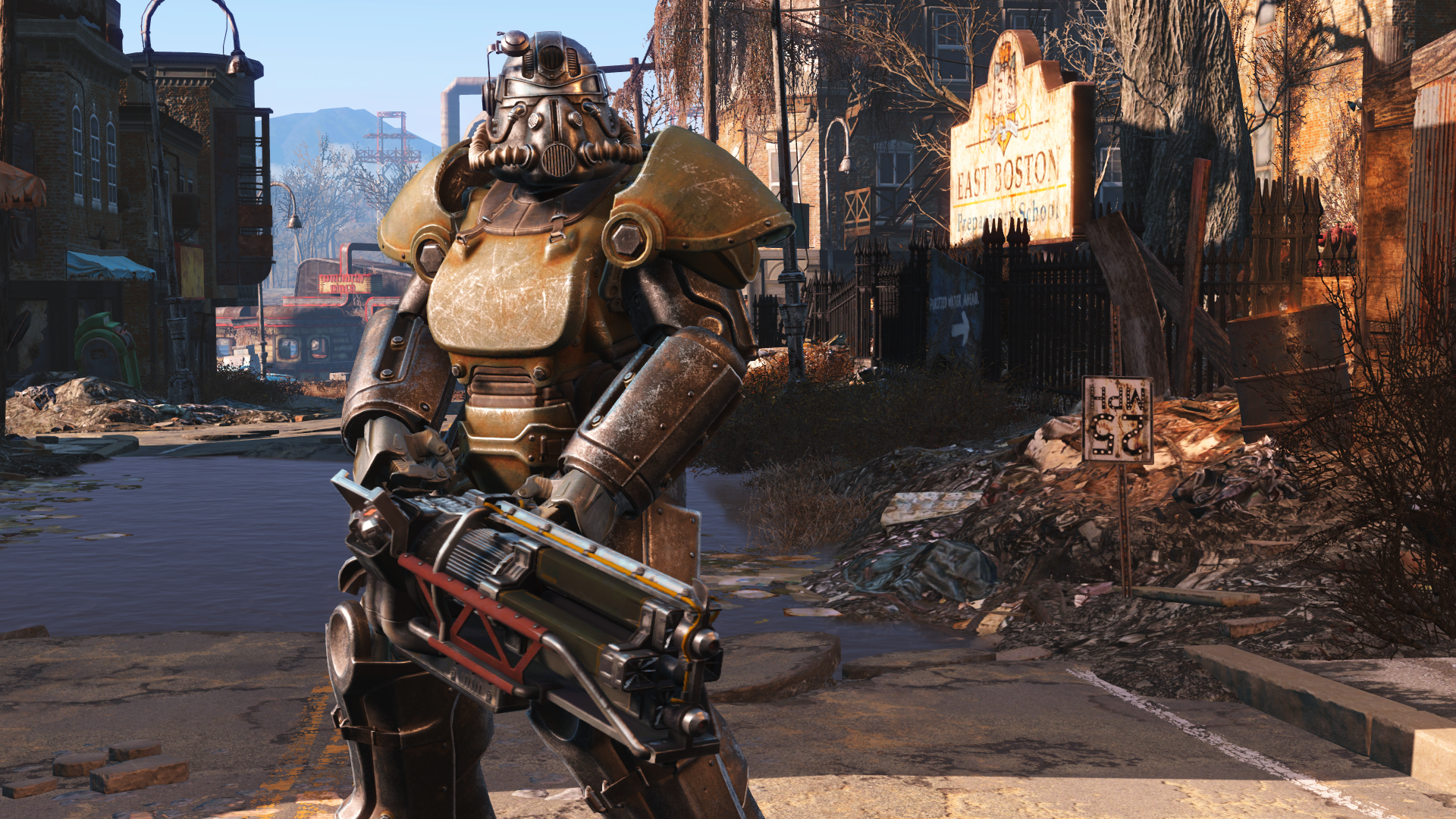
Aside from the map design, graphically the game is sort of all over the place. On the positive side, it’s vibrant, it has some amazing object models that will make you stop running for a change and just walk to look at the things around you. And the lighting effects are top notch. So there are definitely times when you will say aloud, “wow, this looks really great.”
But on the other hand, the HUD is a crowded disaster that lacks any sort of style, and can sometimes get intrusive. Information is often way too large. (I get it. I’m still hidden. Get off my screen). I was really hoping for a sweet, almost hybrid of 1960’s future meets anime sort of display when I put my power armor. What you get are big clunky dials that hinder ⅓ of the screen. You can dial HUD opacity down as much as you like in the options, but that doesn’t solve the issue.
And the textures can get pretty rough. Some of these people, even on PC on ultra, look like they’ve been pulled from a Gumby cartoon. I pray for an HD texture pack from Bethesda, similar to what they delivered on Skyrim. And Bethesda needs to look into new ways to animate their people. The rigid spines of their NPCs is getting dated and it makes running look weird. I’m normally not one to harp on about FOV sliders, but I can say that Fallout 4 needs one. The guns are all huge and just take up too much space. So there are definitely times when you will say aloud, “wow, this looks really terrible.”’
But to counter that point, characters, when talking, do a lot more to emote with their faces, that in combination with a great script and some awesome voice acting is a very positive step forward for the Fallout and Elder Scrolls franchises.
Combat is nice. I found it fun to play in both 3rd person and 1st person points of view and switched pretty regularly between both. The slow motion VATS system is back, but this time it’s a bit more useful. Now you build up criticals through successful VATS hits and can manually activate the critical hit when you think the time is right.
The controls are OK but there are some issues. I started playing the game on console and was relieved to shed my controller for a mouse and keyboard when the opportunity arrived, but I was sad to see that some of the awkward console controls came with it. Some keys perform double duty. The melee button is the same as the grenade button. You can rebind your commands on PC, but those two prompts are permanently stuck together. I couldn’t make my G key be the grenade and my side mouse button to be the melee. It’s both or nothing. Melee is tap, grenade is hold and release. I don’t like that.
The “use” button is the same as the exit power armor button. This combination doesn’t cause much trouble, but while the game happily tells you how to put on your power armor for the first time, it doesn’t really tell you how the heck to get out. I accidentally stripped my suit of parts the first time before I managed to take it off. I even rewatched some of my captured footage to see if I missed a command prompt somewhere. Just a tip for newcomers, exit your power armor close to a power armor station (hold down the use key), and then click on the repair station to “dock” your armor safely… out of the reach of those pesky settlers.
And conversations on PC don’t have numbers next to them. I can’t hit 1, 2, 3 or 4 to make a conversation choice. I have to use my arrow pad. Lame.
The differences between PC on ultra and the PlayStation version are noticeable but not life altering. It looks nice on both. Obviously you’re going to see the prettier version on PC. I saw a fairly steady 60 frames per second on my PC with an occasional dip in the high 30s.
On your journeys, you can bring along one companion at a time. AI companions are meant to do a few things like help in combat. The more time you spend with companions, the more they like you (or dislike you) depending on your actions and their personality. They can point out hidden items. They actually open up some of the most interesting side quests in the game.
You can also use them to help carry your gear when you’ve loaded yourself up with too much stolen office equipment and stationery.
But what are the companions great at? Getting in the way. All the time. They’ll get in the way of your shots. They’ll get in the way in your conversations. They crowd doorways. They steal your kills. They rush in and beat up your precious spare power armor. In my opinion, they need a behavioral script rewrite or give the player the option to select how aggressive they are. They have all gotten me into trouble more often than they have gotten me out of it. I found a way to pacify a gang through conversation and the leader let me go freely on foot if I was gone in 10 seconds. I was gone within the 10 seconds, but guess who stuck behind and started a fight?! I found the game much more fun when I told my companions to leave me alone in the field, but again, it was at a cost to missing out on their stories.
You can now modify weapons and armor to your liking. You want to put a scope on that 44 revolver? Do it. Found the materials to put more pockets in your armor? Get on over to the armor crafting station. Want to put additional functions in your power armor? Go for it. You’re only limited by your level and your perks.
Speaking of power armor, I never get tired of seeing characters getting in and out of that stuff.
Finding new parts for your armor and guns is fun. All the junk that was littering the wasteland before like coffee cups and broken lightbulbs, they all now have a use. You can simply dump your junk into a giant collection and the game will automatically use whichever components are appropriate for the situation. Need copper wiring for a mod or a new structure and it will use an old cooking pot. Need some screws and the game will dismantle a typewriter or a desk fan. Weapons and personal body armor never needs to be repaired (thankfully), so you won’t have to hunt for more 10mm guns to repair your 10mm gun. Your power armor, however, DOES take damage, but you can repair that with steel and circuitry found anywhere in the game world.
I wish there was more personal customization options. A simple color option for guns, armor, power armor and their headlamps is surprisingly missing. There are some styles that you can find, but they’re pretty rare for the power armor, but having the ability to paint my power armor all white to look like a Star Wars stormtrooper or red and yellow to look like Iron Man on my own should be a no brainer. I’m really surprised by that.
By using all the junk and chemicals you find, you can also mix your own medications and other pharmaceutical substances meant for personal use only. At an open campfire you can cook your own food from the animals you’ve killed or crops you’ve grown.
But what most people are REALLY going to like doing is making their own structures. Turning abandoned farms into booming little towns complete with their own shops, and of course, a sweet pad made of the world’s finest junk that hasn’t been totally destroyed by the war.
Building brings in a bit of the that sweet minecraft and lego addictiveness. It only adds to that aforementioned freedom that I spoke of earlier. While building your structures, you need to worry about your population’s food supply, water, electricity and defenses. Sadly there’s no real tutorial for some of these items and there’s a lot of subtlety to learn on your own like how to assign specific settlers to the shops you build or to how to send them on supply runs. What is the proper way to set up your electricity so that lights work? Etc. But all in all, this is a good, good addition to the Fallout franchise. As a sim fan, I would love it if npc needs were a little more complex. And the UI needs a bit of help as well. It’s hard to tell which settlers have jobs and which don’t. (I ended up making a uniform system. Shopkeepers wore suits, farmers didn’t. Guards wore old military uniforms.) I was really hoping that raiders were going to try to mess with my towns more, too.
The system is very usable, but definitely needs touch up.
Speaking of needing touch ups, who want wants to hear about the glitches I encountered?!
I witnessed physics out of control!
Conversation partners disappearing!
Infinite ammo!
Villagers stealing my power armor while I was taking a nap, causing horrific body morphing and then trolling me about giving it back.
Fast traveling and appearing several hundred feet above ground!
It’s an open world Bethesda game, so they’re almost jokingly bound to happen. I guess it’s inevitable with this many moving parts. Because I was so attached the main storyline, I didn’t explore some of the game’s alternate quests. After I reached the game’s “ending” (using that word in quotes), it led to some awkward conversations with NPCs. Some factions were thanking me for sparing the lives of characters I never knew were at my mercy.
It is glitchy. There’s no denying it. The game autosaves quite a bit, so I never felt like I lost any real progress when something would go weirdly. I never experienced a game crash.
Before I wrap up this review I want to point out how much I loved this soundtrack. It is very suiting to both the game world, and the story. It’s exciting when it needs to be but also haunting and sympathetic. It goes beyond being simple background music and becomes part of the story telling.
Even though I reached level 50 and spent a good amount of time in the wasteland, I still feel like I rushed it. Like many past Fallout games, the game begs to be replayed multiple ways, not just to try out the different paths, but to do no fast travel playthroughs, hardcore mode, pacifist or no kill playthroughs, stealth runs, to try out the many different companions and find out their stories. Does it need a patch or two? Certainly. I don’t think anyone would call you a fool if you waited for the game’s first patch. But I love this game. It is an absolute blast to play and there is so much to do! It has big guns, a great story, good crafting, excellent world visuals, and engaging lore. This one gets a worth buy from me and it’s another notch in 2015’s belt.
Tested on: PC and PS4
Developer: Bethesda Game Studios
Publisher: Bethesda Softworks
Platforms: Windows , PS4, Xbox One
Launch Date: November 10, 2015
Review copies provided by publisher