The Division, despite my doubts brought on by the diluted “Ubisoft open world formula” and trailer after trailer of gameplay that didn’t live up to the initial E3 announcement presentation, turned out to be a great game. The cooperative play, the environment, and visual effects steal the show. It’s a third person shooter RPG in the same vein as Destiny and Borderlands, but with an ever-active multiplayer open world. Is it a must-play experience for every gamer out there? Definitely not. The Division appears to be very divisive (pardon the play on words). But those who like it, will love it. Those who don’t probably never will despite what fixes or updates are in store for the game. I love it. It is some of the most cooperative fun I’ve had in a long time and I hope to see more for The Division, not just in the form of updates for this title, but within the Tom Clancy video game universe.
It takes place in New York during the holiday season after a bio-manufactured form of smallpox wipes out most of the population and with it, almost all forms of government have collapsed. What is happening outside the city is unknown, though considering New York is a global hub, things can’t be good.
The player is an operative from a top secret government agency known as The Division. The Division acts 100% autonomously. Their goal is to reconstruct a working form of the United States in the event of a near-cataclysmic event after the United States as many know it today, has fallen. Sort of like secret patriots version 2.0.
Within this game, the player has to quell the uprisings of various violent groups while aiding doctors by procuring virus samples and hunting down leads to the whereabouts of the disease’s creator.
It’s set in a slightly downsized version of Manhattan where players are free to roam the streets and go wherever they want to go. The map is spangled with a variety of collectibles, street encounters with the game’s baddies, and large full-scale missions that take place seamlessly between large buildings, the sewers, the streets and subway system of New York.
The common consensus on the internet: The Division does nothing new with the exception of its Dark Zone experience. While certainly pessimistic, it’s true. The Division doesn’t do anything particularly new, but it does a combine a wide variety of highly polished game elements into one cohesive and functional experience like few other games before it.
Certainly Borderlands and Destiny are shooter RPGs, but neither are third person, cover-based, or even set on Earth. Considering Destiny and the latest entry in the Borderlands shooter series came out two years ago, I see no problems with sharing the same pool water. The world is still in a staggeringly short supply of worthwhile cooperative games, and playing The Division cooperatively is absolutely the way to go. The more people you have in your party, the more enemies the game spawns. The more enemies the game spawns, the more diverse you need to skillsets especially at higher levels. If everyone plays healer, there will be no crowd control and everyone will die. If everyone plays crowd control, no one is really dealing out damage or healing, and everyone will die.
There are three skill trees, Security, Technology, and Medical. By fulfilling the correct experience requirements, players can (and will) unlock every skill within the game, but only two special skills and one ultimate skill can be equipped at a time. While there are some skills that are more useful in the general sense or for playing single player, each skill and its particular handiness is emphasized in the end-game while playing with a group or while venturing in the Dark Zone. At first, I was pretty reluctant to this system, but it quickly grew on me. No one player is forever funneled into one type of playstyle and each character can change their loadout as new situations dictate (again, an option that not many other shooter RPGs have given players up to this date).
The Dark Zone is The Division’s wild west. It’s a central chunk of Manhattan that is completely controlled by the violent gangs and where the infection is at its worst. It is a continuous open world where some of the best gear can be found, but it is also where the greatest challenge lies. The Dark Zone is not only player versus environment, but it is also player vs. player, so while you may be out hunting for better gear, other players may rather be out to hunt you. Intriguing, right? And it is, but it’s also where the game is in its greatest flux. It runs on a completely different leveling system than the core game experience and it also uses a different form of currency, but equipment earned in either place can be used inside and outside The Dark Zone.
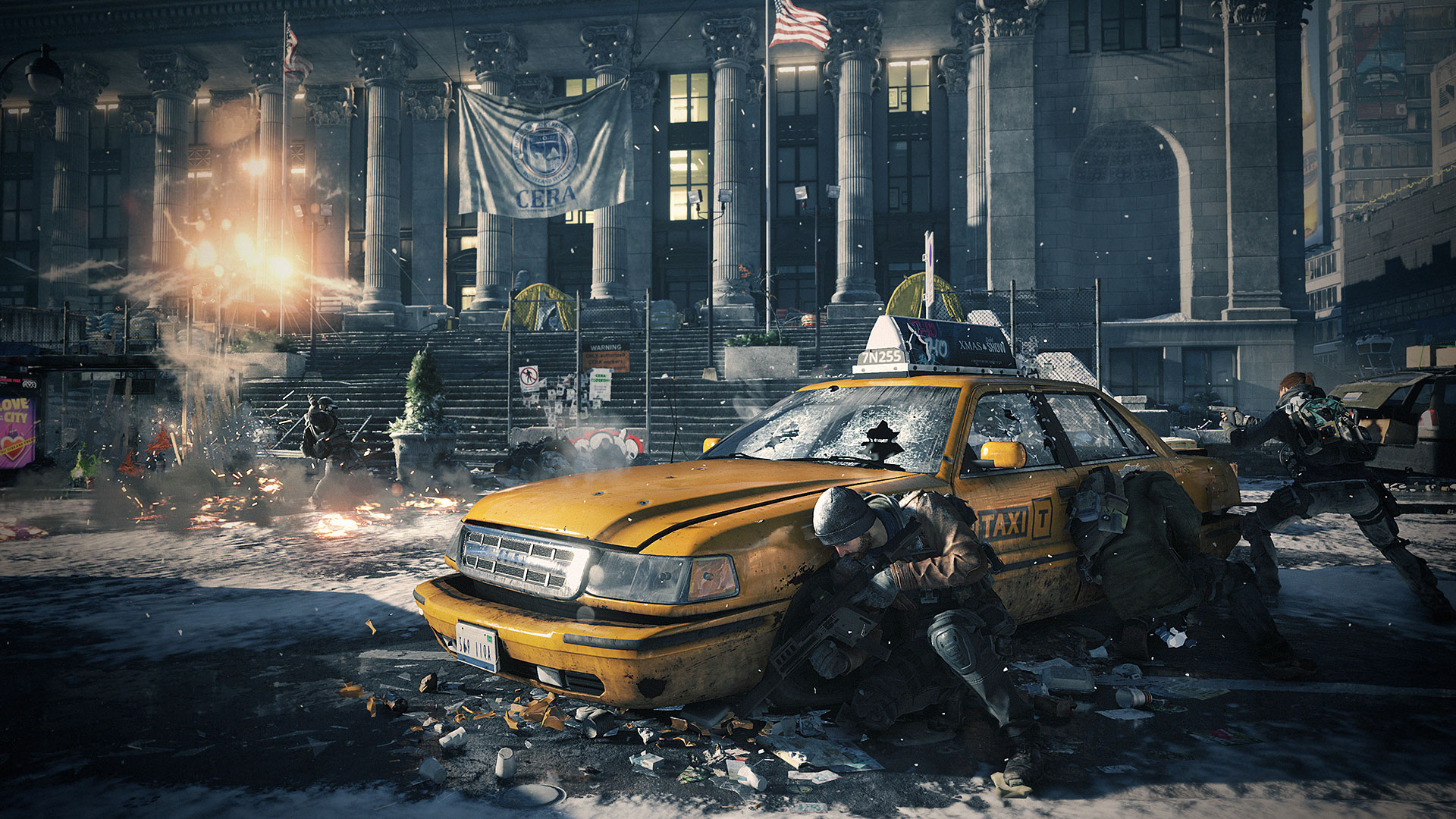
The recreation of Manhattan is nothing short of stunning. Gamers have seen New York in a variety of titles, but never like this. The attention to this world’s detail is absolutely unprecedented. Everything looks authentic on a macro level from the iconic buildings to the subway system down to the micro level of the graphic design on billboards, flyers, store signs, the graffiti on the walls. And then the extra steps that were taken to make it look like an outbreak actually occurred take it to the next level. Corpses just about everywhere. Filling up the subway system. Left abandoned on conveyer belts. Trash bags thrown everywhere (because obviously no one is going to pick them up and run them to the incinerator or to the dump). Evacuation notices can be found in abandoned apartments. Stores are picked bare for supplies. Exploring this version of New York is one of the high points of the game even though it is macabre and at times depressing.
One of the low points is that the world feels dead. In a near-apocalyptic story such as this, having an unintentionally “dead feeling” city is a big setback. Compare this New York which feels unintentionally dead to Red Dead Redemption’s deserts or Pripyat in S.T.A.L.K.E.R.. Those worlds feel INTENTIONALLY dead. There’s a stark contrast between these worlds and it’s largely due to the characters in each game.
The characters in The Division are all pretty forgettable, and the ones you do talk to all have the same personality. Cranky, jaded, dedicated to their work and they all feel underappreciated. I don’t expect to meet any shiny happy people in this world but from a storytelling perspective, it’s not great to have your characters all be the same character. Players can go through all the missions in whatever order they’d like (save for the final mission) and it wouldn’t have much effect on the game’s storytelling.
That’s a gigantic missed opportunity. In a world where the are so few characters, the ones that are left (both the heroes and the villains) all need to carry weight. And the shame is, the villains really could have been interesting characters because their origin stories, are varied, believable, and sympathetic (to a degree).
Rioters are simply civilians who took their need for survival a little too far. Rikers are escaped convicts from Rikers Island, but were left for dead. The Last Man Battalion are a military group that are trying to retain order on the streets through force. The Cleaners (perhaps the most radical of the four groups) are misguided sanitation workers who try to eradicate the disease by burning it out. None of these groups are acting out of hatred, just fear and a lack of overhead.
The backstories are there, but those backstories aren’t distilled and injected into any characters of note.
But not all of the game’s storytelling is so clumsy. Some of the most effective storytelling comes through audio recordings and 3D recreations the game calls echos. The quick and terrifying fall of New York is cataloged in these sometimes shocking details. I listened to every single recording and watched every echo, not out of some misguided sense of completionism–I hate gobbling up dots on the GPS–but because they were made so well. It almost makes me wish that the game’s tutorial segment took place mid-outbreak to contrast a full and functional New York, with the broken and self-destructive one.
That accounts for about 80% of the collectibles in the game. The other 20 percent feel like a total time waste. Collecting the data from broken drones within the city? Busywork. Following arrows on the ground to discover the location of a lost Division agent’s watch? Busywork. There’s no skill in following arrows. There’s no detective work. There’s not even a story payoff for doing it.
There is another collectible within the game that I don’t mind: the survival guide pages. The pages are directly from the companion book The Division: New York Collapse which is an interesting piece of writing in its own right. It’s a survival guide for New York in the event of a catastrophe, except the author of the book appears to have intimate knowledge of the Dollar Bug before it even happened. The current owner of the book April Kelleher has used the book’s margins to solve some of the clues within the text and to use it as a diary for her own events as New York falls to ruin. Interestingly, April Kelleher appears in many of the game’s echos which ties the two experiences together very well. It is much more clever than I would have thought.
The book, like the digital recreation of New York, goes to great lengths to make the experience feel authentic visually. It comes with a map, some missing posters (which can also be seen in the game), and a few other odds and ends tucked into its pages. It is truly a fascinating piece of fiction. April’s story might not be the greatest ever told, but the way it is told alone is worth the experience if you’re a fan of The Division. Alone, both the book and the game are above average, but together they amplify each other’s value.
In the book, however, April talks about how dark New York has become, about how dangerous it is to light candles carelessly at night and how people are not only dying from the bug, but now without a source of food and warmth, people are dying from the elements.
This doesn’t feel like a reality within the game. Aside from the Dollar Bug wiping out most of its residents, New York seems to have power everywhere. With power should come heat and water in most places. While the in-game situation feels dire, it feels significantly less so than the book when you can walk around in people’s apartments that are running entire server farms.
I don’t think the entire city needs to be dark all the time in a video game, but it would have been more dynamic and immersive if some places in the city never see power, and would require the usage of flashlights to explore, especially during the night. And now I’m curious if that’s something a modder could ever put in place.
But otherwise the lighting and visual effects push the game forward. The snaps and pops and explosions from your special skills and grenades are as dazzling to look at on the 50th hour as they were the first hour. The reflections in the water against the dynamic lighting in the sky. It all looks amazing.
And I’d like to put in here, this is the best looking snowfall in any video game ever.
The user interface is also super easy on the eyes, and on PC, there is a lovely amount of customization for it. I turned off the majority of the in-game queues like the cover and climbing systems, because after blacklist and conviction, these controls came second hand. Most of my friends played using mouse and keyboard and had no issues, but I found the game personally more enjoyable using my 360 controller. The point is, it works great either way so pick your poison.
There’s a visual disconnect with the game’s enemies. Most enemies, especially on the hardest difficulties will take a ton of firepower to bring them down. Visually, it looks silly. But playing it doesn’t feel bad at all to me. If the game didn’t have the Tom Clancy name attached to it or if the enemies were fire breathing monsters from outer space, people wouldn’t mind the bullet spongy-ness of it as much. On the flip side to that argument, the spongy-ness of the enemies drastically affects how you personally would want to load out your character.
There’s also a severe lack of enemy variety. You’ll find yourself fighting the same bosses over and over again but with different names or sometimes with no name at all. The random NPCs on the streets all chatter too much and most of the time it’s completely out of context. They’ll shout the Rikers are coming, when it’ll be the cleaners. They’ll thank you for helping them in one breath, then tell you they didn’t need your help in the next. If they could all speak about 90% less and more to the subject, that would be wonderful.
At the time of this review, the loot system seems to be out of balance, and it really lacks the variety in ultra rare or named drops in the top two tiers of weapons. A lot of people will end up with a similar loadout in the end.
Also lacking is the character creation system. For an MMO-lite experience, the options to build your character are severely limited. Meanwhile cosmetic gear is all simply dumped into your inventory in a list instead of picking a style of something, and then picking its color (if that color has been found yet). But that’s a minor UI concern and something that can be updated in future versions.
Ubisoft Massive has been aggressive about updating the game as well, which is wonderful to see. Many of the concerns I have about Dark Zone both the player vs player and the player vs environment gameplay are already being addressed, so I’ll keep my points to the ones I feel either cannot be addressed or might never be addressed.
Right now the game has three economies which is entirely too many. There’s Dark Zone cash which won’t really buy you any gear worthy of your time until you’re Dark Zone level 50 (they definitely need to put in more level appropriate things to spend your hard earned cash on), Phoenix credits which buy high end gear for levels 30 and above. And standard cash which can buy one or two high end items, but for the most part becomes absolutely worthless after level 30.
The Dark Zone truly is a special game mode. It’s as close to lawlessness as you can get in a video game. But since the playing field is not level, people with the better gear will always stomp people with lesser gear. Or, more likely, people who have found exploits will just continue to exploit and ruin the experience for everyone around them. I came across a person who could heal with wolverine-like quickness, essentially making him near invincible. If Ubisoft Massive keeps up with regular updates, this might be a non-issue in time.
In theory the Dark Zone is a great idea and I have to applaud them for trying, but I worry that it is almost impossible to keep in balance. But as an ever-present and dynamic open world shooter, it’s tough to say what the Dark Zone will be like in one month, six months, or even a year from now.
Whatever your thoughts are about the Dark Zone even without it, the game has enough quality cooperative content to keep most people satisfied and occupied for dozens of hours. The end-game challenges will keep fans busy for a while and with some free expansions on the horizon, I think there’s plenty of reason to keep The Division installed.
The Division isn’t a perfect game. It’s not for everyone. But I personally loved it and I had a wonderful time playing for hours with my friends. The story fell short but the world and the lore created here are amazing. I want to see this universe again in more Tom Clancy games, particularly what Sam Fisher and Fourth Echelon are doing to help. People often write Ubisoft games off because of their attachment to Uplay, but I have had no problem with Uplay at all with this game. I found it easy to bounce in and out of friends games and the cosmetic unlocks it offers are always welcome.
I think if you need another cooperative game, or if you like cooperative shooters like Destiny and Borderlands, The Division is an easy game to recommend for purchase. It’s clearly designed from the ground up to be enjoyed with friends. If you’re looking for another single player adventure The Division might not be your thing and for that I’d say wait for a sale.
Tested on: PC
Developer: Ubisoft Massive
Publisher: Ubisoft
Platforms: Windows, Xbox One, PS4
Launch Date: March 8, 2016
Review copy provided by developer