27 Apr

Games have usually been about killing. It’s the simplest objective and it’s the easiest thing to program. Be they Space Invaders or Inky, Blinky, Pinky, and Clyde, the annihilation of ones’ enemies was the initial goal of video games.  It still stands as the primary gameplay feature in 95% of all games.  The simplest iterations of this concept tested only the player’s endurance against increasing odds while more honed systems tested strategy, timing, and precision.

But had anyone ever stopped and considered the phrase, “live and let live?”  In the early 1980’s, someone did—and thus the stealth genre emerged, rooted in the idea that direct confrontation may not always be the best way to defeat one’s enemies. In fact, it’s probably the worst.

The year was 1981 and Muse Software releases Castle Wolfenstein for the Apple II, later to be ported to DOS, the Atari 400/800, and the Commodore 64. You played an Allied soldier trapped in a Nazi fortress tasked to steal the ‘secret Nazi war plans.’ You had a gun, but bullets were extremely scarce and it was best to only kill when faced with no other choice.

At the time, the artificial intelligence in Castle Wolfenstein was revolutionary. Soldiers were alerted if they saw you walking around without a disguise. They heard sounds like gunfire and grenade explosions.

While pursued, normal soldiers could have been shaken off with relative ease, but once you started running into the SS, things got tricky. The SS had no qualms with chasing you from room to room.

If you managed to dispatch an enemy, his body could have been searched for ammunition, armor, and an extremely useful Nazi uniform that fooled the regular guards but not the SS. However, you didn’t have to kill an enemy to get his equipment. If you pulled out your gun to surprise an enemy, more often than not he’d put his hands up and you were able to frisk him for precious supplies. You then had a choice to kill him. The only other method of getting ammo was to use your lock pick to open chests, but didn’t offer enough to keep you alive.

The game succeeded in creating a sense of urgency by using digitized voices for the guards. However crude the sound quality was, the distinguishable German exclamations were enough to make you panic. And believe me—you’ll hear them quite often seeing as there are 60 rooms in the massive five story castle.

This style of gameplay carried over to the sequel, 1984’s Beyond Castle Wolfenstein, but with several changes. To increase the challenge, guards would occasionally ask the player for a pass (which varied by level), at which point you could either show your pass or offer a bribe. Naturally, if you didn’t have the right pass or you didn’t offer enough money, the guard would try to activate the alarm. The grenade was replaced by an incredibly useful dagger which allowed silent kills and the sound effects were greatly improved (in quantity and variety—not quality).

The stealth in the series ended here, though, as Muse Software went out of business in 1987. Id Software acquired the rights to Wolfenstein, which would lead to a landmark title in another genre.

Of course I’m talking about the seminal Wolfenstein 3D, considered by many to be the pioneer of the now ubiquitous FPS genre.  The game had absolutely no stealth elements beyond shooting someone in the back. The game could just have easily been titled something else, but at the time the Wolfenstein franchise was a lucrative one.

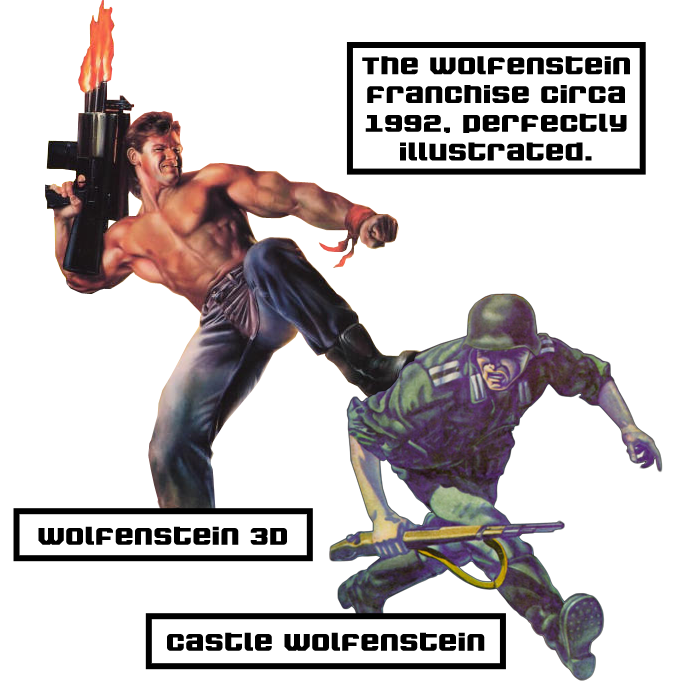
In memoriam of a trailblazer of the stealth genre, I’ll end this article with an image that so beautifully displays the shift of the focus of the Wolfenstein franchise.  The macho man on the left, described by Elder-Geek.com Editor-in-Chief as “Patrick Swayze meets Contra,” is the guy you control in Wolfenstein 3D.  The fellow on the right is the guy you control in Castle Wolfenstein.  Think about it.

27 Apr

header_coming_out_the_shadows_s1

Games have usually been about killing. It’s the simplest objective and it’s the easiest thing to program. Be they Space Invaders or Inky, Blinky, Pinky, and Clyde, the annihilation of ones’ enemies was the initial goal of video games.  It still stands as the primary gameplay feature in 95% of all games.  The simplest iterations of this concept tested only the player’s endurance against increasing odds while more honed systems tested strategy, timing, and precision.

But had anyone ever stopped and considered the phrase, “live and let live?”  In the early 1980’s, someone did—and thus the stealth genre emerged, rooted in the idea that direct confrontation may not always be the best way to defeat one’s enemies. In fact, it’s probably the worst.

The year was 1981 and Muse Software releases Castle Wolfenstein for the Apple II, later to be ported to DOS, the Atari 400/800, and the Commodore 64. You played an Allied soldier trapped in a Nazi fortress tasked to steal the ‘secret Nazi war plans.’ You had a gun, but bullets were extremely scarce and it was best to only kill when faced with no other choice.

At the time, the artificial intelligence in Castle Wolfenstein was revolutionary. Soldiers were alerted if they saw you walking around without a disguise. They heard sounds like gunfire and grenade explosions.

While pursued, normal soldiers could have been shaken off with relative ease, but once you started running into the SS, things got tricky. The SS had no qualms with chasing you from room to room.

If you managed to dispatch an enemy, his body could have been searched for ammunition, armor, and an extremely useful Nazi uniform that fooled the regular guards but not the SS. However, you didn’t have to kill an enemy to get his equipment. If you pulled out your gun to surprise an enemy, more often than not he’d put his hands up and you were able to frisk him for precious supplies. You then had a choice to kill him. The only other method of getting ammo was to use your lock pick to open chests, but didn’t offer enough to keep you alive.

The game succeeded in creating a sense of urgency by using digitized voices for the guards. However crude the sound quality was, the distinguishable German exclamations were enough to make you panic. And believe me—you’ll hear them quite often seeing as there are 60 rooms in the massive five story castle.

This style of gameplay carried over to the sequel, 1984’s Beyond Castle Wolfenstein, but with several changes. To increase the challenge, guards would occasionally ask the player for a pass (which varied by level), at which point you could either show your pass or offer a bribe. Naturally, if you didn’t have the right pass or you didn’t offer enough money, the guard would try to activate the alarm. The grenade was replaced by an incredibly useful dagger which allowed silent kills and the sound effects were greatly improved (in quantity and variety—not quality).

The stealth in the series ended here, though, as Muse Software went out of business in 1987. Id Software acquired the rights to Wolfenstein, which would lead to a landmark title in another genre.

Of course I’m talking about the seminal Wolfenstein 3D, considered by many to be the pioneer of the now ubiquitous FPS genre.  The game had absolutely no stealth elements beyond shooting someone in the back. The game could just have easily been titled something else, but at the time the Wolfenstein franchise was a lucrative one.

In memoriam of a trailblazer of the stealth genre, I’ll end this article with an image that so beautifully displays the shift of the focus of the Wolfenstein franchise.  The macho man on the left, described by Elder-Geek.com Editor-in-Chief as “Patrick Swayze meets Contra,” is the guy you control in Wolfenstein 3D.  The fellow on the right is the guy you control in Castle Wolfenstein.  Think about it.

WolfensteinChange

26 Apr

no yes

By Brent Oxford

Kirby Super Star, released in North America in 1996, is a landmark in the Nintendo library and is still considered by many to be one of the best Kirby games in the franchise. Twelve years later, Nintendo, not being content with simply placing the game to the Wii’s Virtual Console, remade this classic under the title of Kirby Super Star Ultra (KSSU). The result is a game that not only matches the quality of the original, but exceeds it.

Those familiar with Kirby Super Star will know what to expect. KSSU is a collection of 2D platformer games where the objective in most of them is to progress through the game’s levels and ultimately fight each level’s boss. Kirby of course still relies on his flight ability and his trademark power of inhaling his enemies to either use them as projectiles or swallow them to assimilate their power for his own use .

However , KSSU contains nearly double the amount of content of the original. New games include:

•     “Revenge of the King” is a more difficult version of Super Star’s Spring Breeze game

•     “MetaKnightMare Ultra” is a game in which you play through all of Super Star’s main games as MetaKnight himself

•     “Helper to Hero” takes Arena and lets you choose from any of Kirby’s helpers

•     “The True Arena” is an even harder version of the boss gauntlet found in the original Kirby Super Star.

KSSU also contains 3 new minigames, all of which make use of the DS touch screen. They include “Kirby Card Swipe,” “Kirby on the Draw,” and “Snack Tracks.”

KSSU also takes advantage of the DS’ wireless multiplayer functions, allowing other players to join in and play. One friend can help you cooperatively dominate the main game as a helper, while up to 4 players can try to outdo each other in the mini-games. Upsettingly, there is a lack of online functionality.

KSSU has received a noticeable bump in its graphics from the original Kirby game. Far more detail has been added in the game’s sprites, resulting in much more fluid motion and even smoother gameplay. Many of the game’s environments almost have a 3-dimensional look as the colors pop out at you. The soundtrack is equally as impressive. KSSU retains all the music from the original game but also has it’s own share of new tracks for the game’s new modes. All new 3-dimensional rendered cutscenes have replaced all the original game’s 2-dimensional cutscenes, adding another layer of graphical improvement.

Kirby Super Star Ultra is a game meant purely for fans of Kirby Super Star and the Kirby series in general. The game as a whole is on the easy side and most Kirby enthusiasts will probably be able to blow through all the games in about a day. It might take even less for those experienced with Kirby Super Star. However, for 30 dollars, you still get an enjoyable sidescrolling platformer that could arguably now be the best Kirby game made yet.

If you have children, Kirby is a great game for them to play and it’s no problem to play Kirby in front of them either. If you’ve never tried a Kirby game before, this is a great entry into the series.

If you have given up on Nintendo ever releasing the original on Virtual Console, and you have a craving to send Dedede flying, or you want to see MetaKnight’s Halberd crash into the sea again, then Kirby Super Star Ultra is a game that will not disappoint.

About the Author: Brent Oxford has been gaming for over 18 years and started like many of us playing Super Mario Bros. on the Nintendo Entertainment System. This is his first article for Elder-Geek.com

25 Apr

no yes

Ahhhhh haaaaaRag Doll Kung Fu…..

I Love Super Smash Brothers! And I love Little Big Planet! So when I heard that they were bringing Media Molecule’s original creation to the Playstation Network, needless to say I was excited. I never played the original for PC, but from what I’ve heard, it was basically Super Smash Brothers only with realistic physics, HD graphics and a touch of Bruce Lee. What wasn’t to love? When I considered this game, I knew it wasn’t going to live up to Brawl, nor did I expect it to.  After all it’s a ten dollar downloadable game, so the bar was lowered to a certain extent before I even went in plastic fists a’ragin.

So did it live up to my self perpetuated HYPE! Well… kind of (*sigh*). The game has some really great qualities. But the game also has its fair share of problems. First let’s start with the good. The game is basically a scaled down Super Smash Brothers and has the same fun frenzied gameplay. Rag Doll Kung Fu (RDKF) looks fantastic for a Playstation Network game. The high definition graphics are well done, and the Havok Engine is used extremely well. This game has set the bar for what Kung Fu Rag Dolls should look like.

There is a sense of chaos within the game that is unlike many other games. It provides you with an interesting blend of button mashing and strategic planning. Like in Smash, objects appear that give you health, and allow you to hurl projectiles at your enemies. Unlike Smash, you have the ability to hang and swing from objects like Sackboy from Little Big Planet. The Sixaxis controls are used in clever ways. Characters have the ability to meditate and regain health by flipping the controller upside down. You can also slam the controller downwards to help clear the immediate area.

The game offers several original challenge modes such as “Acrobatics!” and “Get the Fish!.” “Get the Fish” is a combination of Capture the Flag and a fighter… only instead of a flag, it’s a fish. Now that’s INNOVATION! Take that Wii Fit!

Unfortunately there are some serious issues with this game. The first and foremost is the lack of online play. The game does have a pointless leader board that teases you with its online functionality. The game also lacks any form of a story mode, other than the ten challenges. The challenges are easy to beat, but difficult to perfect.  With these creative, stereotypical, Enter the Dragon-esque characters, I would have loved to see a campy martial arts story to go along with the game. The games largest focus is its local multiplayer functionality. Although you can substitute players with bots, the bots just do not adequately replace their human counterparts in skill… and smack talk.

RDKF is a full game and not a quick marketing gimmick like some other titles available on PSN or Live. If you love Smash Bros. and think this is going to be Sony’s version of the game, you will be disappointed. The game feels a bit like going back and playing the N64 version of Smash Bros. only with a facelift. On the other hand, what do you expect for $10? If you have a great group of friends coming over who like campy marshal arts movies, then pick this title up. If not I think it might be one to pass on until they either patch it with online play, or drop the price.

One thing’s for sure, it has the best opening theme music this year by far! To hear the theme and watch the Rag Doll Kung Fu trailer, you can visit RDKF‘s official download page here.