02 May

yes

This game is the first huge step in the DS’ battle to distance itself from its ‘kiddy’ image and in that it succeeds on all fronts. Streamlining the GTA experience down to the bare necessities while still keeping the adult-oriented dialogue, plotlines, and objectives makes Chinatown Wars quite unique.

Those of us unfortunate to have played GTA Advance will look upon the newest handheld venture into Liberty City with skepticism. But where its predecessor failed, Chinatown Wars succeeds. It manages to distill the gameplay we’ve come to know and love down to its roots before rebuilding it to suit the platform.

You play Huang Lee, a spoiled Triad brat sent to Liberty City to deliver a ceremonial sword to his Uncle after the death of his father. Upon your arrival, you are ambushed, shot, and left for dead. The sword is stolen and you must begin your quest to restore your family honor and recover the artifact.

Along the way you’ll meet dozens of characters that fit right in the GTA universe and the typical formula plays out with you performing tasks and missions for various people as you progress through the storyline.

The gameplay is excellent. The driving feels smooth and responsive, though the motorcycles are a bit hard to handle. The targeting system works well enough and while it’s not perfect, I can’t think of any way to improve it. Included are gameplay improvements seen in recent entries such as swimming and climbing.

But the game also brings several new features to the table. The most prominent one is definitely the drug-trade mechanic. Anyone who has ever played the cult PC classic Dope Wars will feel right at home as you travel around the city, picking up tips and buying/selling all sorts of narcotics. The money you make from trafficking more than makes up for the lack of monetary reward for the missions. If you want to do well in the game, drug trading is something you’ll have to do—it’s not some ancillary feature.

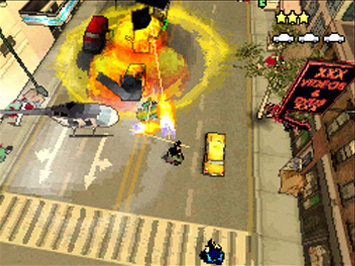
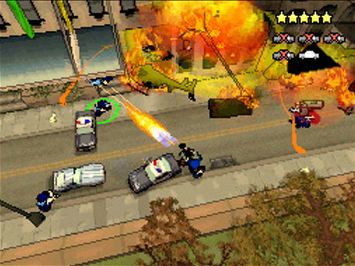
The way you escape the police has changed, as well. You can outrun them and stay out of sight for awhile, or you can take out your pursuers’ vehicles by any means necessary. It makes it seem much more realistic and it adds a whole new dynamic to being chased by the cops.

The game also makes use of the second screen, which serves as a map, radar, and inventory page. You can zoom in on the map and set markers, you can choose an option to have directional arrows appear on the roads on the gameplay screen (an invaluable feature if you’re unfamiliar with the layout of Liberty City).

Additionally, your PDA serves as your options panel, your email, your radio tuner, and even your gun shop—rather than having a few locations around Liberty City, you can now have guns delivered to your Safehouses. Or you can hijack Ammu-Nation supply trucks or raid hidden weapons caches around the city.

Another thing that Chinatown Wars does especially well is make creative use of the touch screen. Rather than having a slew of useless mini-games, you are prompted to use the touch screen at appropriate times. When stealing cars, you often have to manually hotwire it—something that’s incredibly nerve-wracking when you have a wanted level. If you want some Molotov cocktails, you stop by the gas station and fill up as many bottles as you can, trying not to spill too much.

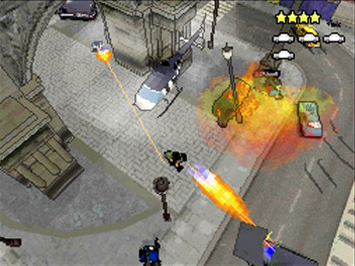
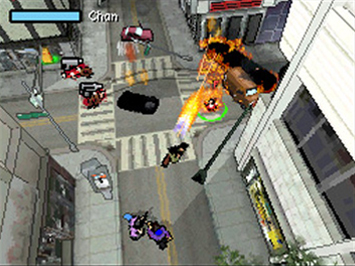
The game is, of course, not in full 3D like the PSP entries in the series. It isn’t exactly top-down, either, like the earlier titles. Instead, the game employs a 3D isometric camera that rotates as needed with excellent accuracy and reliability. As a result, the player is always in view. The addition of a user-controlled camera allows for even greater freedom. And speaking of freedom—the Liberty City of Chinatown Wars is almost an exact replica of that of GTA IV.

For a DS game, Chinatown Wars looks great. There’s no licensed music and no voice acting, but that’s to be expected given the limitations of a single DS cartridge. However, cutscenes done in the typical GTA art style relay plot elements adequately and well written dialogue fleshes out the characters and compensates for the lack of voice talent.  As for music, you’re given a selection of stations that mimic certain genres of music and they serve their purpose.

This game is a must-own for the more mature DS owners. On a platform with so few games targeted at an older audience, it’s rare that one is executed so superbly. And with the main storyline taking about 30 hours depending on how sandbox-happy you are, you’ll certainly get your money’s worth.

29 Apr

no yes

So just recently got myself an Xbox 360, and the first game I bought for the thing was really the one reason wanted a 360 in the first place: Fable 2. I had unfortunately bought into all the hype of the original Fable, and so with Fable 2 I vowed to myself that I wouldn’t let it happen again.  In the end I realize that I probably could have ignored that promise and still be able to enjoy the game, but I’m still very glad I made it.

fable 2 title screen

Fable 2 is all about choice. For example, you start the game as a young orphan in the streets of Bowerstone; the capital city. In this intro sequence you’ll be asked to acquire 5 gold coins and 5 wanted contracts, and how you go about obtaining these will be decided by moral choices. The effects of these choices won’t be felt immediately but will echo into adulthood. This is how the world of Fable 2 works –quite realistically I might add—the only immediate effect of your actions is the increase or decrease of both your purity and morality meters, which effect how the world at large reacts to you. But more importantly decisions also have outcomes in the main story of the game, and ultimately the ending.

Cleverly you’ll see visual indications of your current morality and purity stats in both your character and your dog.

At the start of the game you are known as Sparrow, you and your orphaned sister decide by the convincing of a mystical old lady to buy a music box from a local rare goods vendor, which is why you need the 5 gold coins. This is no ordinary music box however, as it is said to be a magical trinket from “the old kingdom,” but just when you and your sister are about to reap its magical rewards it vanishes in thin air. Shortly after this event a peon of Lord Lucien the mayor of Bowerstone, is at your doorstep. You are then rushed up to Fairfax castle to meet with Lord Lucien. It turns out that Lucien knows a great deal about this mystical music box, and has more questions than the two youngsters could possibly answer. Eventually he finds out that the two of you are “heroes”, legendary warriors with the power to wield magic, also known as the chosen. In a panic he decides to kill both of you. Your sister dies and you barely escape. You are then taken in by the mystical old lady and raised in a gypsy camp. Years later after reaching adulthood you are tasked with stopping Lucien’s evil plans and avenging your sister. This is where your quest starts. The story isn’t Oscar material and has its fair share of clichés, but it does a good job at motivating you and it’ll keep you interested and engaged at all times.

I set out to be the most evil and corrupt SOB possible. At the end of the game I owned the entire town of Bowerstone, lived in the Fairfax castle with my undead wife and had maxed out all my stats to become a tall, brutish, demon. And all I had to do to achieve that was mercilessly slaughter thousands and selfishly deny world peace and prosperity in favour of mountains of gold. I’d like to suggest that this doesn’t reflect my personality the slightest, but seeing as I do pretty much the same thing in every RPG that gives me the choice; perhaps Peter Molyneux is on to something.

evil combat

Graphically the game holds its own…It won’t blow you away, but the art design more than makes up for that.  The hallmark moment of wonder in this game is definitely the sunsets – which will easily make you pause, but after seeing 50 of them they become more annoying then wonderful. Where the real production value shines through though is in the voice work and sound design. Unlike similar RPG’s you never notice that some villagers have the same voices, in fact it’d be hard for me to confirm that statement. The writing is top notch and genuinely preformed, giving the game a real immersive quality. The music is also very iconic and memorable; every time I paused the game chills.  Since this is my first real 360 experience I’m not sure how noteworthy this is, but I felt like the loading screens where unnaturally long and frequent in this game, even after I installed it to the hard drive.

Fable 2 is an RPG. Because of that you might expect to shift through menus upon menus of stats, but luckily that’s not the case—not that stats aren’t appealing in their own right. No, Fable 2 takes a more circuitous approach. You gather orbs to upgrade spells and abilities, and everything else is done in the background, free from your concern. There are basically 3 types of orbs (aka points) in the game, each has a specific playing style attached to them and the more you use one style the more orbs you get for that style.

You can choose between or combine melee, ranged and magic combat, but towards the end of the game you’ll have enough points to max out every style. Melee is your standard fare button masher, with an added depth. The enemy will frequently block melee attacks so timing is everything in this mode, you’ll want to make sure your attacks actually do damage, but at the same time you don’t want to leave yourself open to attack. Later in the game you also get new and faster combos as well as the ability to counter attack similar to Assassin’s Creed’s counter attacks. Ranged combat is at first pretty boring, you simply point your character towards the enemy to auto lock-on…usually 5-6 shots will kill them. After a few hours and upgrades though, you’ll be able to manually aim in first person and you’ll also have upgraded your damage and speed. This is when the ranged combat truly shines, at some points I used it exclusively to pick off enemies from afar and blast those foolish enough to get closer into oblivion. The magic seems to be where most of the focus has gone. Every spell has two modes, the targeting mode lets you aim at specific enemy and unleash the spell on solely that enemy.  While the area of effect mode expands a circle of effect around you, every hostile character within the circle will be affected. Every spell also has 5 tiers which you earn through upgrades; to cast a tier 2 spell for example you have to hold down B long enough that it’ll charge up to a class 2 spell. You can customize which spell should be used in which tier, and once you get enough spells you’ll find the most effective combination to use on different enemy types. Your dog can also attack, and you can find or purchase books to upgrade his stats, but most of the time he’ll just get in the way. I ended up having to heal him after almost every battle. Overall the combat in Fable 2 might seem straight forward at first, but it has a surprising amount of depth and makes for some really long lasting appeal.

The world of Albion is filled with all kinds of people and monsters, some are friendly—others…not so much. Fable 2 has everything from Hobbles; small cave dwelling murloc sounding gnomes, to giant rock and tree golems. During your adventures you’ll encounter several of these beast as well as human opponents, they are all pretty easy to take down and require little strategy (magic always works). But once in a while you’ll run into the giant miniboss golems, to take these beasts down you have to shoot tiny weak spots around their body—much like any Zelda game. Navigating the world is a breeze, you always have a golden thread in front of you showing exactly where you need to go, and if you’re too lazy to do that you can always just teleport to your quest location. Very often you’ll see your dog run off with a “treasure” or “dig spot” mark above his head, this means that he’s found something and if you follow him it’ll lead to free stuff, if you don’t he’ll eventually stop barking and join you at your side again.

Another big part of the gameplay is of course the social interactions you make. This can have a big effect on how well you do in the game. If say a shop owner likes you enough he’ll give you better prices, letting you buy more and better items and potions which directly affect how easy your next mission is going to be. You can go about the game in a manner of different ways, if you play the game as a good and selfless character people will generally like you. But if you—like me— went with the easy and evil lifestyle; everyone will inherently hate your guts, what you have to do then is to convince them otherwise. You do this through expressing certain emotes, the effects of which are completely arbitrary. With enough practice though you’ll figure out which emotes work on certain people.  When in doubt you can always just give them a diamond. This system also echoes over into quests, where you’ll often be asked to convince a person to follow you to a certain location. You can achieve this either by scaring/threatening them or making them like you.

The high point of this social gameplay is getting married and having a child, something that is disturbingly easy in this game. Do enough “he-hey!” flirts in a row and it’ll make any woman (or man) melt in your hands. All you need to do then is go out and get an engagement ring, buy a house and lure you’re newly beloved into unprotected sex. And voila there is now a crib with a newborn child next to your bed. After that I found that family life was largely irrelevant, and as long as I kept my better (undead) half happy with a ridiculously high daily household budget I could pretty much ignore her and the kid.

So to sum it all up Fable 2 is an absolutely incredible game. It does have its problems, but in the end the good by far outweigh the bad. The game still hasn’t lived up to the initial promises made by Peter Molyneux for the first Fable, but I honestly find it hard to believe any game could. It’s a good value. I finished it in roughly 20 hours, but you could easily stretch it out to 50. I am really glad I didn’t hype myself up for this title, because although I would still enjoy it, I wouldn’t have enjoyed it nearly as much.

Side note: Fable 2 does have an expansion pack out on XBLM for 800 points right now called Knothole Island; I didn’t play that for this review, but expect a mini review on it in the future, as well as any other substantial updates—to any games.


28 Apr

no yes

By Arles Suarez

Varrigan City has been taken over by terrorists. They’ve cut off all of the city’s connections to the real world. It is now the stage of the game show Death Watch, where the contestants must kill each other to survive. The surviving citizens of Varrigan City are now contestants in this brutal game. It is a mad world indeed, and you, Jack, must put an end to the madness by killing the competition as grotesquely and creatively as possible.

In MadWorld, you take on the role of Jack Cayman, a man with a prosthetic arm that somehow contains a retractable chainsaw, and must fight your way to the top of the competition through a series of timed levels (30 minutes apiece). The game plays like a beat ’em up. You must fight your way to progress through the levels, but unlike beat ’em ups where you basically punch and kick your way through enemies, you must be resourceful and find weapons or hazards throughout the level to eliminate the enemies within. Simply slicing someone in half will earn you some points, but slamming a tire on someone, shoving a few signposts into his skull, and then finishing him off by impaling him ass-first on a large spike will earn you about 4 or 5 times as many points. Roughing up an enemy until he is weak can allow you to finish him off; these kills can be rewarding but also cringe-worthy at the same time.

madworld 2

When you earn enough points, you activate a “Bloodbath Challenge.” Whenever you start a challenge, you are instructed on what your objective is in a short and very funny cut scene involving the Black Baron and his girlfriend Mathilda. These little challenges include Man Darts, where you use a baseball bat to swing at your enemies and slam them into a giant dart board. There is also the Turbinator, which involves you to toss competitors into a jet turbine, resulting in a bloody mess. These challenges are very unique, and will most likely have you laughing and cringing at the same time.

After earning enough points, you face off against the level boss. Sadly, the bosses are introduced in the most simplistic of ways by saying some one-liner and then immediately charging you. I’d have preferred a method of boss introduction like the one present in No More Heroes where you get some back story before and after boss encounters.

There are also some Road Rash-esque motorcycle sequences in the game, but aren’t very memorable. These sequences are very simple and just involve you riding and chopping enemies up. They are ridiculously easy and quickly get boring.

While the game is extremely violent and filled with gore, it’s over-the-top violence like what you’d find in Kill Bill Vol. 1. It’s really hard to not laugh at!

Madworld 1

The controls in MadWorld are very good, although they can take some time to get used to. Thankfully for a Wii game there isn’t too much waggle motion with the Wii Remote. You use your chainsaw by holding the B button and swing the remote horizontally or vertically for horizontal and vertical slices respectively, A to punch, Z to jump, and C to lock-on to enemies. You switch weapons with the left and right d-pads and shake the nunchuck to do a backflip (which is very useful when facing a group of tougher enemies).

There is a small problem with locking on, since you have to hold the C button for 2 or 3 seconds (I can never really tell) and let go to successfully target someone. It’s not really a pain, but it can take a little time to get used to since most games simply have you tap the button to lock-on. Another problem with locking on is that you target the nearest enemy . It’s fine when there’s one or two enemies around you, but when there’s five or six guys and a mini-boss surrounding you, you’ll seriously hate the lock-on system in the game. Thankfully it’s not very necessary to lock-on to enemies and really only useful against bosses.

The game features a Sin City-esque art style and is in black and white (except of course the blood). The black and white graphics are very stylish and suit the art style very well. There is a lot of detail in the environments, character designs, and other parts of the game. Blood will stain the walls, but the enemies will disappear.

Every aspect of the sound in MadWorld is phenomenal: the voice acting, sound effects, and especially the music are great. The voice acting is very well doesn’t feel phoned in. Greg Proops and John DiMaggio, who both voice the announcers of Death Watch are deliver their comic relief lines perfectly and add a lot of humor to the game. The other characters’ voices are spot on as well especially the VA Jack and The Black Baron.

The story is very well-written and will keep you hooked, as it is pretty interesting. Sadly, the ending could have been better, but for a beat ’em up I feel like I shouldn’t complain.

madworld3

Although the game is only 4 to 5 hours long, there is some replay value. After completing the game, you can unlock the katana and double chainsaw weapons as well as a hard difficulty which gives new meaning to the term “frustrating”. There are also a plenty of Death Watch challenges that you can complete.

Platinum Games did a great job with MadWorld and I must congratulate Sega its efforts. I truly recommend that you purchase this game if you are looking for a new, unique, and fun experience for your Wii. It will definitely suit your hardcore needs.

Hell of a start Platinum Games, hell of a start.

About the Author: Arles Suarez has been gaming for the past 12 years. The first game he has ever played was Ultimate Mortal Kombat 3 (so as you can see he likes violence in games to be over the top and silly). His favorite games of all time are Mother 3 (which is an upcoming review for the site) and Conker’s Bad Fur Day. This is Arles’ first review for Elder-Geek.com.