
25 Nov

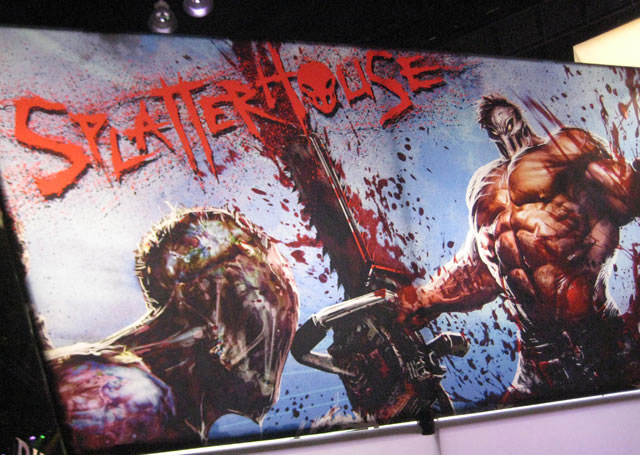
This reimagining of the classic gore fest trilogy of video games had a troubled production history with the original developer Bottlerocket being removed from the project for unknown reasons. Without a developer, the remake’s future was left up in the air. That is until a new developer was hired by Namco Bandai, finishing up the game. Long time fans of one of the first violent video games were thrilled that this game would end up being released. But would it be faithful to the originals?

In this game, you once again control Rick Taylor, who is murdered during the opening of the game. He once again visits West Mansion at the behest of Dr. West, him having Jennifer for personal reasons. Shortly after they enter, Jen is kidnapped by the demented doctor and Rick is attacked by West’s demonic minions.

Moments from death, Rick notices the ancient Terror Mask on the floor near his pool of blood. Looking for a host for its powers, the mask begins to talk to Rick, promising to help him rescue Jennifer if Rick agrees to help the mask. Putting the object on, the Mask possesses Rick, turning him into a hulk of a man complete with many new killing moves and combat powers. Setting off in pursuit of Jennifer, the game begins.

While Splatterhouse may appear to be like pretty much every other 3rd person action game on the market today, it is the little details that make the graphics stand out. It is a nice effect to see Rick’s combat damage heal in real time. Seeing a severed arm stump grow back and missing chunks of rib flesh regenerate is very cool indeed. The backgrounds are also very imaginative; full of demonic scenery and landscapes full of viscera. There’s a reason this game was mentioned in Fangoria’s June 2010 issue, and it isn’t the theme alone.

This is a good thing, as the enemies aren’t very creatively designed or memorable. They exist mostly as obstacles in Rick’s way for the player to kill. The bosses don’t fare any better, and are just larger with cheaper attacks. Some of them have imaginative designs, but their monotonous visuals in combat make them pretty stock. They might be boring to watch, but at least they are fun to kill.

What the game does do right visually is its depiction of violence and the brutality of enemy kills. Rick has a plethora of attacks with everything from clubbing blows to ramming attacks to several types of grab moves, all with bloody goodness to go along. The Splatterkills, special attacks that can finish off weakened enemies, are great to watch, but you may find yourself tiring of the same animation every time you execute it.

Music is a mix of macabre melodies and hard rock/heavy metal tracks by bands such as Mastadon. While the instrumentals are reminiscent of the Genesis games, the band tracks sound generic to me, adding little to the game’s heavy nature. They seem to be included only to promote the bands rather than set a mood.

The voice acting is very good all round, with particular excellence from the voice of the Terror Mask, the man known as Jim Cummings. He delivers the mask’s many quips with relish, making for some of the best voice work I’ve ever seen in a game. While some may believe that this takes away from the mystery of this once Mayan mask, it is still great fun to hear the voice of Tigger deliver such hilarious lines. He also has quite the potty mouth, but I wouldn’t have it any other way.

Shanelle Gray does a good job with Jennifer’s dialogue, despite the script occasionally degenerating into the standard damsel in distress dialogue that even the best VA’s can’t do much with. You can only hear so many varieties of screams before you get tired of it. At least the flashbacks give her some good lines. Lastly, Fred Tatasciore gives some great vocal effects for several of the monsters in the game. After his similar work in Left 4 Dead, he seems like a natural at this stuff, probably the best since Frank Welker.

Splatterhouse plays much like God of War or Devil May Cry, with a singular character who collects powerups by defeating enemies, gaining new abilities, and killing more enemies. It’s an established genre, but I’m not tired of it yet. The series has always been well known for its gruesome weapon kills and those return in force, with the highlight being a chainsaw battle against Biggyman in one of the middle chapters.

An interesting element to this game is the lack of health pickups. Health can only be restored by making use of the Splatter Siphon ability. As long as you have some of the necro (magic meter essentially) you can drain blood from the enemies and surroundings for some quick life restoration. Much like Ninja Gaiden Black, this can lead to some tense moments when you have to balance defense with enough offense to stay alive.

While the enemies aren’t as aggressive as in Gaiden, this system still serves to make the game feel different. It’s enjoyable to see a game when you can’t just always sit back and wait for the enemies to telegraph their attacks. There is also an emphasis on mixing up the attacks Rick uses, as some enemies will outright counter a move that normally works great against other foes.

The controls are responsive overall with an easy interface based on mixing light and heavy attacks. Several attacks can be charged as well for additional damage and variety. The Splatterkills are similar to QTE’s in other games, but can be frustrating to complete. This is because the button prompts aren’t very clear at first, they aren’t on screen very long, and there is no way to pause during them to get a better look. Patient players will be able to figure them out eventually, but this is one area of the controls that I hope is ironed out for sequels.
There is also a neat throwback to the original Splatterhouse games. There are times throughout the game that the action goes to a 2D side-scrolling camera with death traps to avoid. This is a fun homage to the first 2 games in the series, in which the game was really easy if you knew how the enemies attacked and when to counter. It’s a nice touch that old-school fans will appreciate, especially with the ability to smack the enemies into the foreground with a 2 x 4. Add in the fact that the original trilogy is unlockable complete with the uncensored arcade original, and you have a lot for old-school gamers to like.

Even though Splatterhouse is a very good 3D action adventure game, it is fans of the series that will get the most mileage out of it. Non-fans might be scratching their heads, wondering what the big deal is if they haven’t played the original series, given how many references the game has to the originals. Overall, this game is a must purchase for Splatterhouse fans and a rent for everyone else. If you do rent it, be sure to take a long look at its unique elements rather than just dismiss as a God of War clone, an unfair comparison that does video game history no favors. So grab that lead pipe and make this house live up to its name!
24 Nov

I walked into Donkey Kong Country Returns with the wariness of a child sitting on a whiskey-scented mall Santa’s lap. I mean, I have good reason right? Nintendo’s blitz of old-school games hasn’t exactly impressed me. Metriod: Other M was a little too melodramatic and Kirby’s Epic Yarn was more of a beautiful child’s plaything than a revitalization of a long untouched series. If you read my Donkey Kong Retrospective you know that I had some heavy doubts when it came to this final push. Could the Rare gem that was Donkey Kong Country be revitalized with a Retro touch? The answer is yes, yes and a thousand times yes.

Donkey Kong Country Returns is an expertly creative platformer that’s charm far out swings it’s boorish name. It all takes place on that same island we’ve visited so many times before. A volcano has erupted and unleashed a swarm of maleficent melodic masks that hypnotize all of the islands inhabitants with their catchy tunes and uses them to scoop up all of the bananas, including DK’s secret stash (which is still hidden under his hut for some reason). Now, Donkey Kong and Diddy Kong must roll into action to recover the stolen fruit and save their animal friends (or kill them all, it’s hard to tell).

The game is pure platforming bliss. The music is elegant, the scenery is gorgeous and the gameplay is tough as nails. Don’t worry though; most of the more difficult parts can be overcome at the expense of some cool thinking and a handful of lives. The difficulty is reminiscent of classic Mega Man games, you may die a few times but once you get the lay of the land down you can practically run through a level.

Donkey Kong Banana Heist

DK should really invest in a better security system.

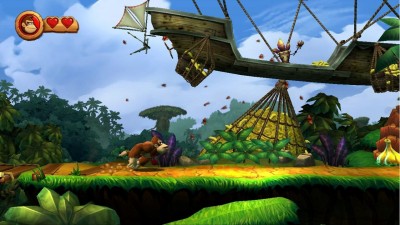
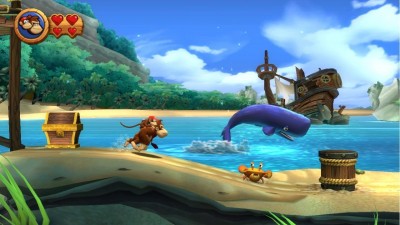
What really pushes DKCR in front of titles like New Super Mario Brother’s Wii is its attention to detail. Every level feels like an organic environment. When DK pounds, plants and trees shake on all plains. Pirate ships battle in the background and a small action can send ruins a-crumbling far in the distance. Even the camera work is engaging, it pans and zooms into some impressive vistas that put Castlevania: Lords of Shadow’s stagnant scenery to shame. As a subtle compliment, the music in these levels is a wonderful mix of classic tunes and new ambiance. Even the energetic boss battles are accentuated with minute notes that compliment the comical tone that the game possesses.

The levels are short, much like the original series, but the difficulty and variety keep them from getting old. You’ll find yourself dodging waves, riding mine carts and flying barrel rockets and I never felt any of these tasks aged as I went. The island map, a-la Yoshi’s Island, is a blast from the past and the clutter of bonus features in levels will keep you working for a long time. Every level has KONG letters, puzzle pieces and a time trial to beat. If you like doing everything than this is great, but the rewards for such sacrificed time are simply artwork, music and the mildly entertaining dioramas. Still, the game sports some surprises that will keep you hooked for quite some time as long as you can stomach the challenge and experimental surprise deaths.

Living Backgrounds

The dynamic backgrounds are an amazing touch and sometimes elude to future troubles.

Nothing is without faults though. While the platforming is solid, the DK and Diddy dynamic is lackluster at best. In single player, Diddy Kong is reduced to a double jump power-up and in multiplayer he is relegated to more of a tag-along partner than an asset. I was disappointed that I never got to take the younger Kong’s reins seeing as though I actually like the little guy. Similarly, the waggle, while not being any encumbrance, adds very little to the game. It does have its place, like in a frantic punch out at the end of a boss fight, but I mostly found that the awkward flailing disturbed the solid physics and controls the game touts so highly.

While the music is outstanding, the sound effects are awful. Many of the utterances out of the characters are cringe worthy and I found myself hurrying through Cranky Kong’s Cabin in an attempt to avoid his awkward grunting. Cranky’s presence brings me to one of the games few shortcomings. He is the only returning character from the classic franchise aside from our heroes. Yes, K. Rool and his Kremlings are gone. Maybe it’s just my nostalgia talking, but the myriad of angry animals in DKCR just never possess the  same charm or threat I felt from K. Rool and the gang. Sure they die in fun ways and some of the bosses are more than amusing, but the lack of a cohesive enemy front made me idle through the bad guys and focus solely on completing each level.

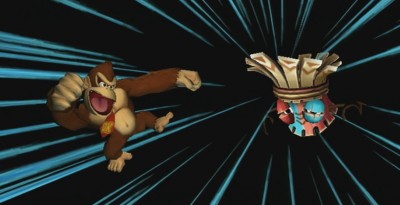
Donkey Kong Punch

The new enemies just never live up to the originals.

Donkey Kong Country Returns does exactly what the title insinuates. It makes you want to return to your Wii, return to the classic difficulty of old-school platformers and return to Kong Island for another romp in the treetops. The game is the best thing we have gotten on your little white PS3 controller charger in quite some time. I strongly recommend that everyone who has become jaded by third person shooters and open world action titles to hunker down with this little piece of history and see why us Elder Geeks got into the medium in the first place.

24 Nov

Tenchux’s  Super Metroid Remastered project has launched it’s official site – http://www.8bitx.com/supermetroid/
The goal of this project is to raise funds for Child’s Play Charity, a charity to give sick kids in hospitals their most desired games, toys, and movies.

Today Tenchux will be releasing a brand new track from the upcoming Super Metroid Remastered album – What Would Samus Do?
The album will be completely FREE and released on Dec 15th, until then we’re getting a track a day on Tenchux’s Official YouTube page from this album.

From Tenchux: “This is the time for you, the fans, the supporters, to help by spreading the word of Child’s Play and this album. Make posts on your local gaming forums about this. Link it on your Twitter and Facebook too! I even just put this on Reddit. Give it a thumbs up if you can!”

http://www.reddit.com/r/gaming/comments/e7tfr/super_metroid_remastered_an_album_for_the_charity/

Below is the link where donations are ALREADY happening. We can raise more than $32 dollars for kids can’t we?

http://8bitx.com/supermetroid/donate

24 Nov

Joining a list of artists including No Doubt and Courtney Love, Guns ‘N Roses frontman Axl Rose is suing Activision for a total sum of $20 million, in response to the in-game appearance of former GNR guitarist Slash in Guitar Hero III: Legends of Rock.

According to court documents obtained by Reuters, Rose claims that he authorized the inclusion of the GNR song “Welcome to the Jungle” on the condition that the game would not include any reference to the former band member, or his subsequent activities in Velvet Revolver. According to Rose, Activision broke this agreement when they included an in-game likeness of Slash and featured songs by Velvet Revolver, which we released as DLC shortly after he game hit store shelves. Additionally, Activision used the likeness of Slash to promote the game by placing it on the cover of the game, and by featuring him on-stage during the performance of Welcome to the Jungle.

Axl Rose and Saul Hudson, more commonly known as Slash, have been in conflict ever since Slash left the iconic rockband in 1996. Activision has not yet formally responded to the lawsuit. (more…)