
24 Sep

Hi there, internet. It’s been awhile. I used to write articles about video games, then I went away for awhile and wrote a very long graphic novel. It turns out that writing a graphic novel is kind of like getting kicked in the balls with the alphabet.

Anyway, the book is done and I have a few moments free before some other deadline rears its head and the alphabet ball-kicking thing starts all over again. So I’m back. But not to talk about video games. Mainly because, compared to the other editors at this site I know jack-all about video games. And to be honest, I don’t even really know what “jack-all” means. Probably not at all what I am using it for.

See, video games and me, we used to spend a lot of time together. But the last few years I find myself and video games growing further and further apart. It’s not that I have a family I need to feed or am exhausted from taking care of some baby. Babies make me angry and families can feed themselves. No…

I will warn you now. I am going to use analogies I would normally avoid. But in this instance I can not deny that the analogies are simply the easiest means to communicate.

My job is to write things. Ideally, things that people like. Despite what people think, writing is not just a process of waking up and dragging your ass across the room to a keyboard, hitting the keyboard a few times while eating leftover pizza while your inner voice debates on whether or not to put on pants (the correct answer is “no”). While I would not deny that the above IS crucial to the experience, writing is also about filling your head up with other people’s precious labors as if your brain was a Cuisinart. Then blending said ideas on high-speed until what you are working with is new and different and alien to anyone who chooses to look at it. You, as the writer might recognize your sources, but if you have done your job right, most other people will be oblivious.

An important part of this process is the filling the brain part. You get out what you put in. Playing games means filling that brain container of mine with the content of the games. The nuances of storytelling. The character development. The structure of the story. I consume these. I process them. And they pass through my system, being digested by the inner thought process only to emerge as…

Well… what things usually emerge as after being digested.

I know… there are many games out there with brilliant writing designed by geniuses whose unique approach to combining the individual gaming experience and the art of storytelling transcend the most critically acclaimed novels/film/theater/ect… I know this. I know good or great storytelling in games exists.

But I’m too busy playing Angry Birds on my iPhone to properly investigate the realities of my own argument. Which is my way of saying: Yes. I am a hypocrite. No, I am not entirely serious. Only kind of serious. A little bit. It’s called hyperbole, and I know at least 25% of the internet understands it.

So…

I’ve found that many of the games I might enjoy on a gaming level are not interesting to me on a storytelling level. And that I was spending a lot of time, essentially participating in stories that did not excite me or inform me or make me feel involved. And that this not only affected my immediate enjoyment but also my creative output.

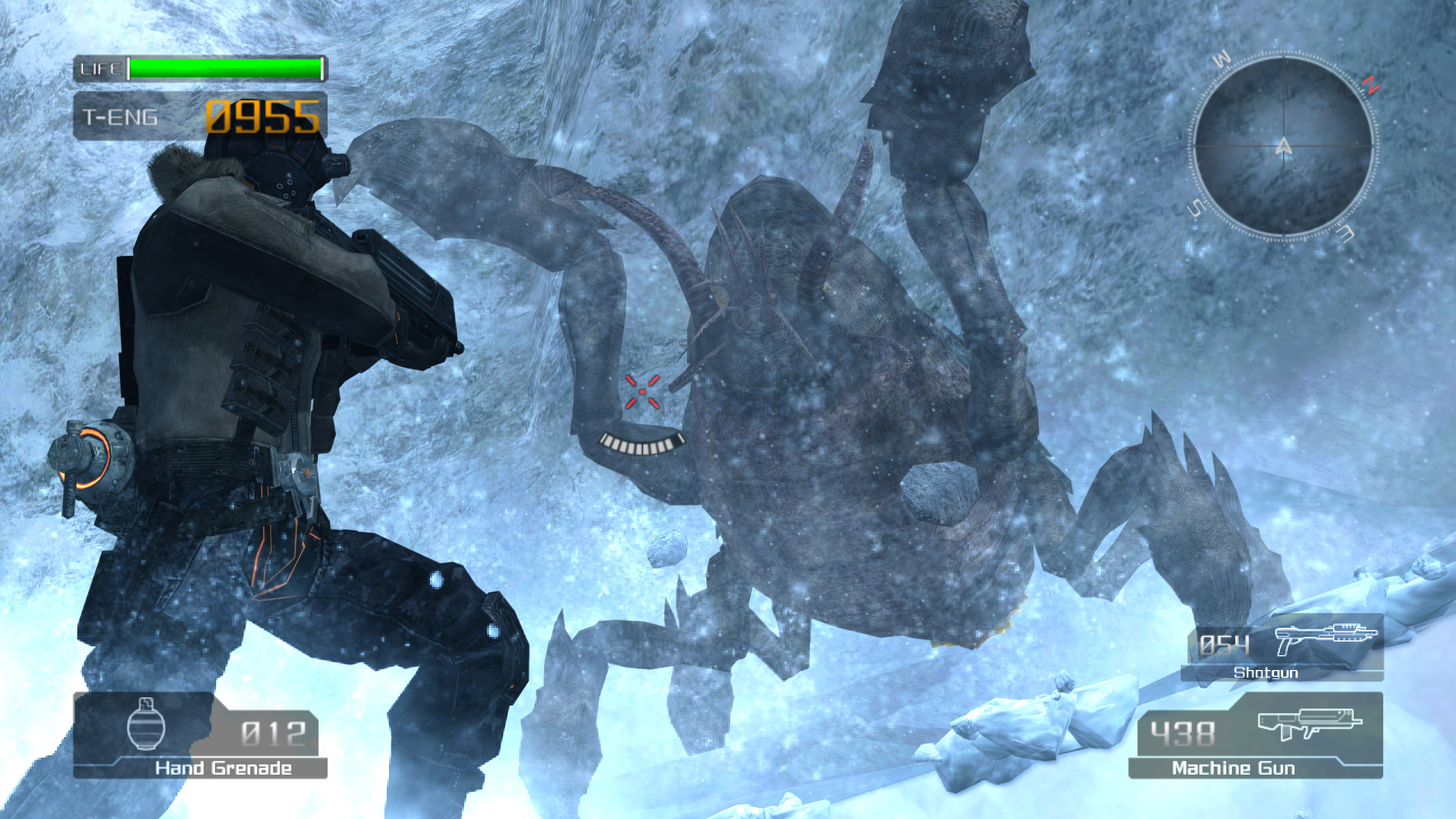
I think the tipping point for me was Lost Planet. I loved the game play of the first one. Mainly because I love snow, and playing in digital snow while crazy big snow worms try to eat me is an automatic win. I know the game had a story. A bunch of characters that did not grab me doing a bunch of things that seemed amazingly irritating. Incredibly complex concepts were advanced to explain why I was running from the ice worms. Because apparently, it’s not enough that I don’t want to be eaten.
Words should be weighed, not counted.

I played the game at length. And I enjoyed playing it immensely. So much that I played it a second time. And I still have no idea what the plot of the game was. But despite not grasping the plot (or not caring enough to grasp the plot), I still find myself influenced by the details. And I’d rather find myself influenced by details I like. Something that I don’t feel a need to purge my mind of afterward.

So I turn to games less. And I argue to my friends about the failure to deliver solid storytelling in games. And then…
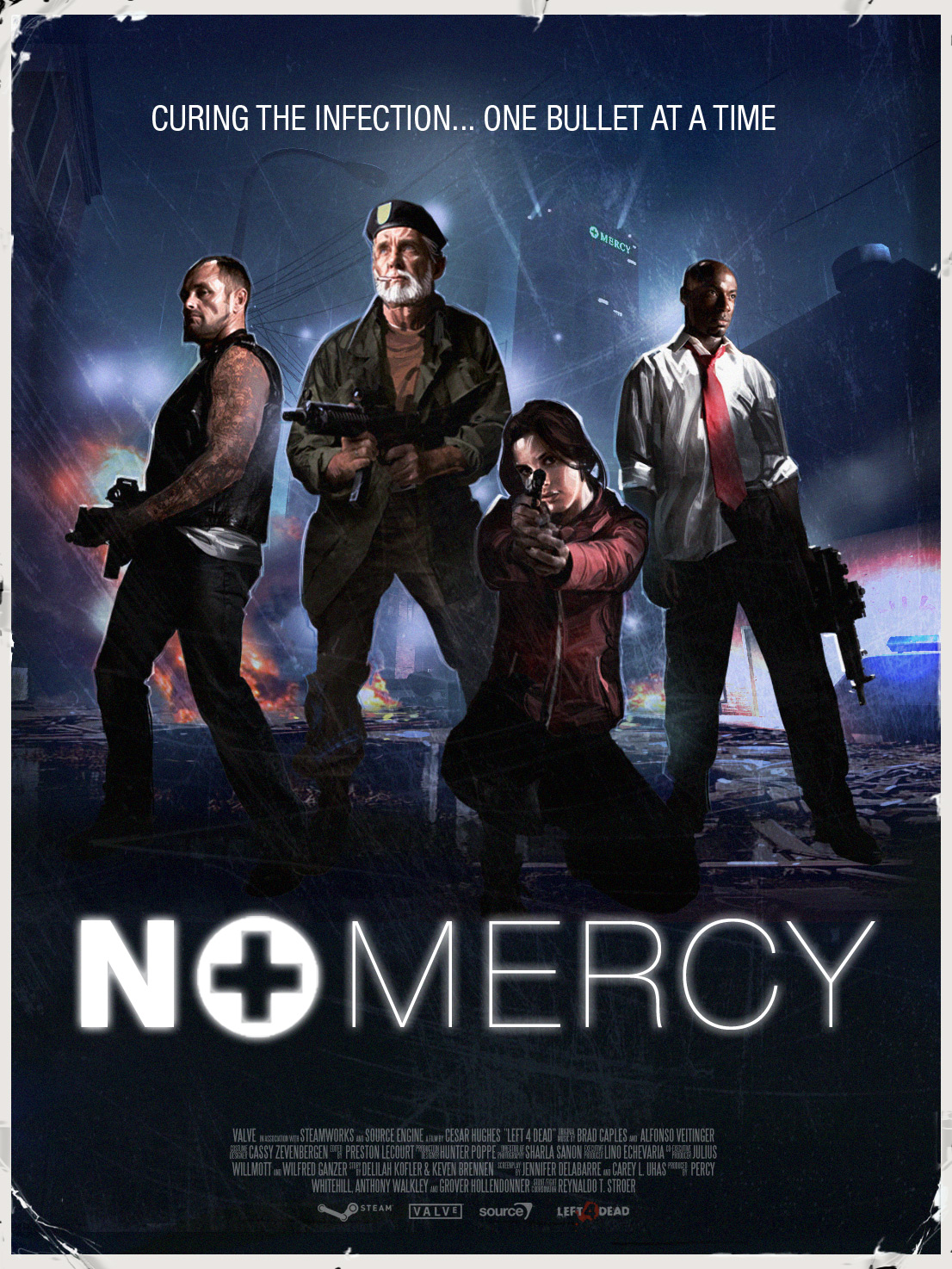
Four people with guns against zombies. How did they meet? Don't care. What are they trying to do? Survive. Fantastic. Sign me up.

Then along comes something like Left 4 Dead (and a bunch of others, but again: hyperbole). A game that absolutely understands that the most important rule of writing. Anything that you don’t need to advance your story? Cut it. Four people. How did they meet? Don’t care. What are they trying to do? Survive. Fantastic. Sign me up.

Some people I know will argue that the above isn’t a story. Wrong. It’s a story in the modern medium of gaming. A story where you know all you need to and your mind fills in the blanks. Something you can jump into and lose yourself in. Where the player becomes the storyteller and writes the script by pressing buttons. Which isn’t that different from typing, in a weird and totally different kind of way.

Anyway… point is, you can tell a great story by letting the players just play the game and experience the world you have crafted. Or you can include mind numbingly dis-interesting cut scenes about a boy whose father was blah blah blah blah blah and whose destiny is blah blah blah blah blah… yes, in the second scenario you might have written something that on the surface is a complex story with complex characters. But unless you’re really, really, really good at doing this, all you have produced is an incomprehensible time suck.

And because of this, I rarely play video games anymore. Or more to the point, I have grown far more selective in what I choose to play. I know I’m missing out on some great experiences, but I take comfort that there is a vast library of amazing content I can someday visit when I feel like turning off my brain and just playing.


23 Sep

While Medal of Honor is being developed as a direct competitor to Call of Duty: Black Ops, the studio head of Treyarch, Mark Lami, has stepped up to defend the EA LA “Danger Close” team in light of the recent backlash. In an interview with MCV, he called it unfair to single out games, while books and films cover equally controversial topics.

Talking about Call of Duty: Black Ops, Lamia stated that Treyarch’s game covers “the Cold War era and there are definitely some controversial topics in there. But I look at it as creating a piece of entertainment and we are strong advocates of creative freedom. […] Our story weaves itself around all kinds of controversial historical periods, but there have been many books and movies that do that, so to single out games in that way seems unfair.”

Earlier today, we reported that a member of the US Special Operations forces spoke out against the upcoming Medal of Honor game, going as far as calling it a Taliban recruitment tool. (more…)

23 Sep

The PlayStation Move has finally arrived, and it’s brought with it a decent collection of games both big and small. But what about the technology behind the Move itself? Earlier in the year we wrote a comprehensive feature detailing the promised functionality of the Move, so does the finished product live up to its promise?

Table Tennis in Sports Champions

First let’s get one thing out of the way, your experience with move will greatly vary depending on what game you’re playing. In the gladiator and table tennis games included in Sports Champions I had the most fun I’ve ever had with a motion gaming device, but the other Sports Champions mini-games, in addition to Kung-Fu Rider, were simply abysmal. The problem is that they either don’t match the movement made by the player with the action on-screen, or that significant bugs or input-lag is constantly present. So choose your game carefully, and keep in mind, that just because the game itself is bad, that doesn’t necessarily mean the technology is.

A big selling point for Sony was that the PlayStation Move would give you one-to-one precision motion control at no significant cost to performance. And they’ve delivered on that promise, the Move is truly precise, and at no noticeable cost to graphical fidelity or frame-rate. It might not be one-to-one, but it may as well be because you honestly won’t notice the difference. It can feel a bit odd at first, and you’ll have to adjust yourself to the idea that your full-body movements are miniaturized on the screen (depending on the size of your TV), but once you get past that it’ll feel smooth and natural. Though a big screen TV is certainly recommended, you should be able to make do with size 27″ and up.

Kevin Butler showcasing his 1337 archer skills!

The great thing about the Move–compared to its current competitor the Nintendo Wii–is how it requires you to put your whole body into the game. If you want to punch someone really hard in the game, you’re going to have to really do it in real life. The Move almost perfectly measures the distance your hand travels in a swing, as well as it’s speed. Meaning that in the gladiator mini-game in Sports Champions, the harder you swing the more damage you do. To let you know you made a successful hit, the rumble feature in the Move controller kicks in just as your sword makes contact with your opponent, with the intensity of the rumble varying depending on the strength of your blow. In addition , not only does the Move detect the position of the controller and it’s speed, it also detects its angle. Meaning that in table tennis you can, with ease, hit swing balls, screws and high balls, simply by adjusting the angle of the controller to turn the paddle.

The final ace up the Move‘s sleeve is its ability to do augmented reality. With augmented reality you can make in-game items magically appear in your hand (Move controller) through the camera feed. It works by tracking the Move controller and simply overlaying a fitting object (baseball bat, sword, gun) onto the glowing orb. It effectively cuts away your fingers, as the handle of the object usually overlaps them, but you don’t really notice due to the huge cartoony nature of the objects. This feature means that your living room could be the game arena, where you can be tasked with hitting incoming baseballs in what appears to be your living room. It’s a highly immersive feature that works really well, but unfortunately it’s little more than trivial since as-of-yet there isn’t any good software to support it, with the exception the childish but decent EyePet.

Of course, the Move has its weak points. You’ll have to find a perfectly central and steady location for the PlayStation Eye for it to work ideally. I had some issues in this regard when trying to balance the camera on top of my rounding slope Samsung flat screen. It’s also crucial that the Move controller’s glowing orb is visible to the camera at most if not all times, the motion control still functions when it’s not, but at much lesser precision. And finally, though the realistic and complete movements required by the move are immersive and fun, they can get quite exhaustive to the average geek, which can be both a good and bad thing.

Start the Party, a party game featuring augmented reality.

I can do nothing more than tip my hat to Sony for what they’ve done with the Move, they’ve managed to combine the PS2 era EyeToy with the competitor Nintendo’s Wii. And in doing so they’ve created something truly special. When writing this I almost felt like I had to nitpick to find something negative to say about the thing, as it all sounded a bit too good to be true. But it is a bit on the expensive side, coming in at 180$ for two Move controllers, one Navigation controller, the PlayStation Eye, and the game Sports Champions, which is really the combination you’ll want in order to experience all that Move has to offer. It also has a limited selection of games at the moment, let alone good ones.

As a technology Move is simply superb, and is something I would recommend every gamer try. If you’re not particularly interested in motion gaming however, you can probably wait a bit with picking this one up. New and better games are on the way, which will undoubtedly make it a sweeter deal, and while the price likely won’t go down anytime soon, random store-sales are allays a possibility. This one is worth buying, but not necessarily right now.

For more detailed information on the PlayStation Move go here.

23 Sep

The Halo franchise has been the flagship of both Xbox consoles ever since the launch of the original Xbox back in 2001. Today, nine years after the release of the original Halo: Combat Evolved, developer Bungie is handing the franchise over to Microsoft-owned 343 Industries. But before Bungie turns its full attention to its partnership with Activision-Blizzard, a final installment in the series will serve as a parting gift to the hordes of fans the developer has amassed over the years.

Possibly the most prominent console-exclusive title being released this season, expectations for Halo: Reach are high. In fact, Bungie has added fuel to the fire by making it clear that all of the content they ever wanted to put into a Halo title would be perfected, and stuffed in this single game. The game delivers on most of the promises that were made over the past few months, and Halo: Reach clearly rises above its predecessors on virtually all levels. And while the game may fall short on a few aspects, the most critical components are executed flawlessly.

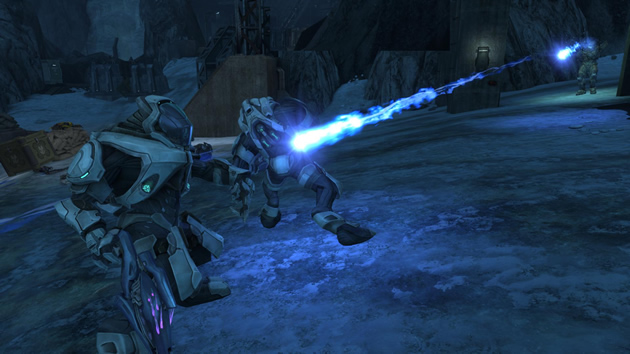
For the first time in the series, the Covenant Elites finally do their name justice. They effectively utilize their high dexterity to flank players and will generally avoid a direct confrontation with Spartans unless they can catch a player out in the open. Their strong AI, combined with the adaptive difficulty that increases their strength as more players join a game, makes it almost impossible to take down a high-ranking Elite with less than 3 players in a 4-player Legendary match.

With respect to the competitive multiplayer component, this most important change from Halo 3 is that many of the playable modes have been streamlined. Rather than containing separate sets of ranked and unranked multiplayer playlists, Halo: Reach contains a small set of general playlists that include all important modes, such as the standard free-for-all, team deathmatches, team objective matches, and large team battles. The newly introduced objective-based game type known as Invasion is a welcome addition, while the highly competitive Arena mode will allow players to play in tournaments against players of roughly the same skill for “Seasons” of one month each.

Besides regular competitive play modes, Bungie also introduced matchmaking for cooperative play modes. Online cooperative play for both Firefight and the campaign were available in previous installments, though users were only able to play these with friends in the past. Firefight matches initiated through matchmaking are limited to a single round of five waves, though matches consisting of multiple sets can still be created as a custom match. At this time, the service offering matchmaking for campaign missions is unavailable, as Bungie wishes to prevent new players from jumping into the story halfway through the campaign. Players who wish to play through the campaign with their friends are still able to invite their friends directly into a game. Matchmaking functionality for the campaign will be made available next month.

Headhunter, a highly entertaining mix between death match and objective based gameplay, is the only major game type being added to Halo: Reach. However, the extensive map creator / editor that is included in the game will allow players to mix and match game types as they desire.

Though the original Halo is commonly regarded as having laid the foundations for console-shooters in general, the series is normally not considered to be one of the most innovative franchises on the market. Instead, the series is characterised by fast, rock solid gameplay rather than innovation in terms of game modes or gameplay elements. It is therefore unsurprising that Halo: Reach fails to introduce any major innovations to the genre, and in fact appears to take a step back in comparison to features introduced in its predecessors. Despite becoming less and less common in modern games, the health bar is reintroduced after having been removed in Halo 2, while the ability to dual-wield weaponry has also been retired. However, the lack of a dual-wield ability has allowed for better balance between the weapons themselves.

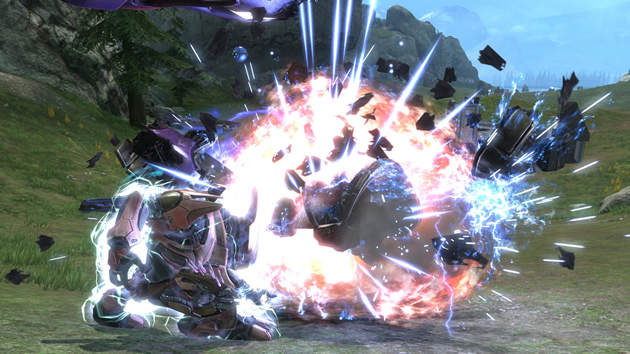
Armor abilities, which replace the equipment found in Halo 3, are possibly the most important gameplay addition to this installment and do a good job of mixing up the action. Prior to spawning onto the battlefield, each player is allowed to pick a loadout with a specific weapon and a unique ability. Each of these sets have their own strengths and weaknesses, and the abilities generally complement the player’s primary weapons well enough to make them effective in combat from the very moment they join the fray, rather than requiring players to scavenge weapons from the map before being able to take other players head on. Effective use of these abilities can turn the tide of a battle, though some abilities have very limited value outside team-based matches.

The armor abilities are a great addition to the gameplay. Some abilities, such as Sprint (exclusive to Spartan players), Dodge Roll (exclusive to Covenant Elite players), and jetpacks increase mobility, while others such as active camouflage, Armor Lockup, Drop Shield, and Hologram play significant roles in combat. However, several abilities, such as Armor Lockup, have the potential to allow a player to cheat death in team matches. Armor Lockup, besides rendering a player immobile and invulnerable for a few seconds, also disables vehicles that try to run that player over. Small vehicles, such as Mongooses and Ghosts, are destroyed when hitting a "locked" player head on.

In general, the multiplayer aspect of Halo: Reach forms a perfection of game modes and gameplay elements that have been introduced in previous installments or in other games. The seamless integration of all imaginable modes of competitive and cooperative multiplayer make Halo: Reach a game that may last gamers for years to come.

Unfortunately, while the multiplayer component of Halo: Reach comes close to achieving perfection in the non-tactical FPS genre, the campaign does not manage to fully live up to the hype that has been created in recent months. During the first few missions of Halo: Reach, the game widely misses the mark when it comes to creating an engaging storyline. At this point, the game pales in comparison to the atmosphere created in Halo 3: ODST. However, as the story progresses and the Battle for Reach clearly begins to take a turn for the worse, the members of Noble team begin to show themselves as a team that realizes it may be the final, yet failing, hope of an entire planet.

As the Battle for Reach, during which the events of the game take place, forms a direct predecessor to the events of Halo: Combat Evolved, the story appears to be tasked with tying together some loose ends that may make the overall timeline an easier to understand for most players. However, as the Battle for Reach has been detailed from various perspectives in two of the Halo novels, the game seems to have difficulty in maintaining balance between adhering to existing canon and adding enough story of itself to be able to stand on its own legs. One might expect that this situation would lead to a longer, more extensive storyline in order to compensate for the number of topics that need to be addressed. Sadly, this is not the case. The story clocks in at around 6 to 8 hours and includes so many references to locations, persons, and events that play a significant role in the overall Halo universe, that the story becomes somewhat of a mess. Overall, the “core” of the story is solid, but almost all of the in-canon references will be lost to all except those who are familiar with all of the games AND the novels. Those who are unfamiliar with the overall canon may still find the story of Noble team enjoyable, as the interactions amongst the Spartans and the sense of hopelessness that takes over during the final few missions manage to redeem the campaign. Still, the campaign pales in comparison to the stellar multiplayer aspect of the game.

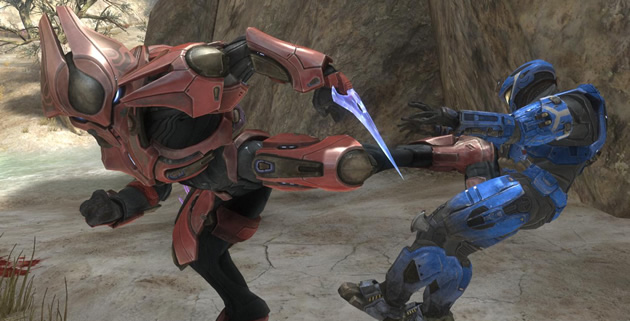
The number of assassination animations has increased since the Beta in May 2010. Furthermore, they appear somewhat easier to pull off and take less time than they did previously, making it easier to use them in combat. Still, triggering an assassination roots the player in place for roughly two seconds. Despite the risk, the animations are so impressive that few players will let an opportunity to assassinate another player go by.

In short, there is an incredible amount of fun to be had while playing Halo: Reach. It offers a wide array of competitive and cooperative multiplayer modes, and due to a fantastic AI and adaptive difficulty when playing cooperatively, both of these aspects have the potential to entertain for multiple months, if not years. The story itself doesn’t quite measure up to expectations and falls short of the level of quality that is evident in all other aspects of the game. Still, the campaign is high-paced and the missions are fun enough to play through repeatedly with friends even if the story itself does not pull you in.

There is almost no excuse to not purchase Halo: Reach if you own a Xbox 360 and enjoy non-tactical shooters. It is perhaps not the “One Game to rule them all” that the hype would have suggested, but within the genre, it comes pretty damn close.